Food Systems, Nutrition, and Health
CPHN
July 22, 2026
Washington households continue to face food insecurity amid rising costs and uncertain federal support, WAFOOD6 survey finds
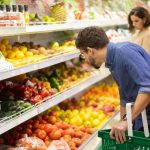 OLYMPIA, Wash. – Washington households are grappling with the sustained pressure of rising prices, strained food budgets and growing uncertainty about federal food assistance programs, according to the sixth wave of the Washington State Food Security Survey (WAFOOD6). The survey, a partnership between the University of Washington, Washington State University and Washington State Department of Agriculture (WSDA), gathered responses from 5,717 Washington households between March and April 2026.
January 7, 2026
Farming for the future: Building resilient food systems in a changing environment
 Jennifer Otten is interviewed by the Center for Health and the Global Environment at University of Washington about the effects of environmental change on food systems, and offers a vision for what resilient food systems look like in practice. “A resilient food system is one that can absorb shocks like climate change, pandemics, and economic...
December 15, 2025
Households using more of the most popular WIC food benefits stay in the program longer, UW study finds
 New research has found that households who redeem more of their benefits in the most popular food categories are more likely to remain in the program long-term. Assistant Professor Pia Chaparro is first author on the study published in JAMA Network Open. “Finding ways to identify kids and families that are at risk of dropping...
December 8, 2025
With community fridges, neighbors feed each other
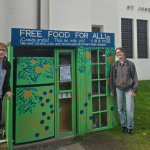 FSNH faculty Marie Spiker will collaborate with UW Urban Freight Lab to improve safety and efficiency of hyperlocal food sharing via community fridges that are accessible 24 hours a day for the public to take and leave food. “Because they’re decentralized, it’s hard to know whether a micropantry is full or empty, or whether a...
October 31, 2025
Statewide effort to put more whole grains on shelves and plates gets $19 million boost
 New statewide initiative to put more healthy, climate-friendly grains on people’s plates will include faculty from the Food Systems, Nutrition, and Health program as the project’s implementation science team including Jennifer Otten, Sarah Collier, and Marie Spiker. The FSNH team will examine how innovations in grain breeding and food product development can be successfully adopted...
October 13, 2025
Wait, Are Carbs Actually Awesome?
 UW faculty member Adam Drewnowski is quoted in this article discussing perceptions about carbohydrate consumption, and helps clarify how to choose nutritionally optimal carbohydrates which can be beneficial to your diet and long term health.
September 29, 2025
Seattle to launch first connected network of community food micro-pantries
 FSNH faculty member Marie Spiker is involved in this pilot research project that will retrofit existing micro-pantries in Seattle with sensors to create a “cyber-physical” network. The system will anonymously track pantry use, donation patterns, and food safety, giving communities real-time data to improve food distribution and reduce waste. The project also aims to strengthen...
September 9, 2025
Some refined grains are surprisingly nutritious
 Adam Drewnowski’s work in a recent study published in Nutrients that combined diet records with health markers such as weight, waist size, insulin levels, and food costs to identify foods which not only improved health, but were affordable. Drewnowski said, “Our evaluation took whole grain content into account, along with fiber, vitamins and minerals. By...
August 25, 2025
UW faculty member contributes to American Heart Association advisory on ultraprocessed foods
 The American Heart Association (AHA) has issued a new science advisory examining what is currently known about the growing impact of ultraprocessed foods (UPFs) on nutrition and public health. Published August 8, 2025, in Circulation, the advisory highlights the evidence linking excessive consumption of UPFs with adverse health outcomes, offering a comprehensive review of the...
August 11, 2025
USDA freezes UW project that turns Washington shellfish farmers’ seaweed problem into soil solution for land farmers
 The Blue Carbon, Green Fields project was a multi-year collaboration between the UW, Baywater Shellfish, Puget Sound Restoration Fund, Washington Sea Grant, Washington State University, and farm business incubator Viva Farms, focused on removing more than 17,000 pounds of seaweed from shellfish beds and applying it to crops on four local farms. The U.S. Department...
Next page